
A deer encounter needs braking room before an escape move
Autumn deer movement puts the roadside back into the driving scan. Early slowing and a controlled lane position protect more than the vehicle that first sees the animal.
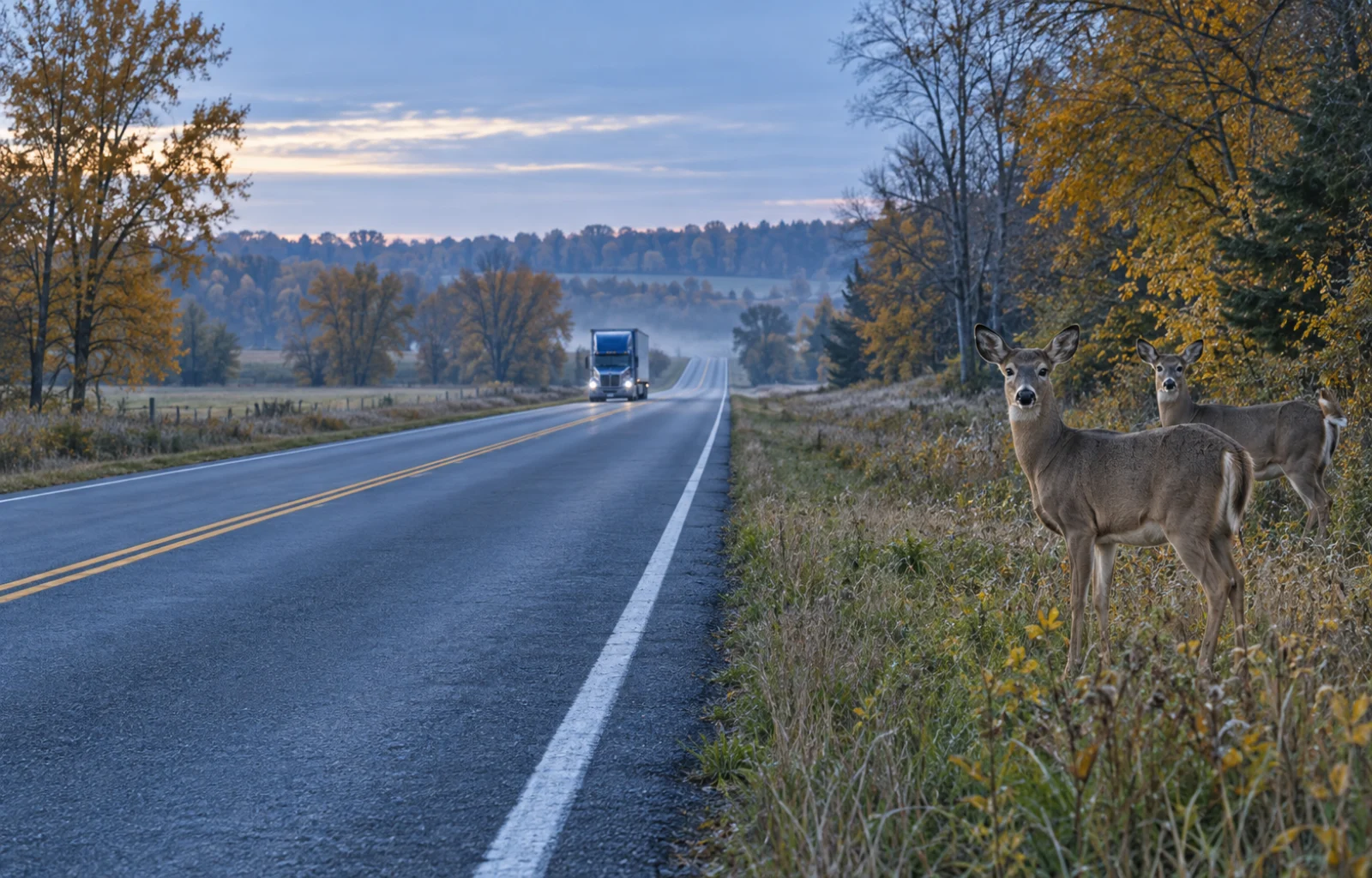
A deer at the edge of the pavement creates two problems: the animal may enter the lane, and a sudden attempt to dodge it may send a vehicle somewhere more dangerous. The useful decision begins while there is still room to slow. This autumn road-safety resource draws on agency guidance checked October 17; it reports no new crash or newly issued warning. Its question matters to delivery drivers, commuters and families across regions: how can a roadside sighting become a controlled response instead of an abrupt escape maneuver?
The seasonal concern has a documented basis. Virginia’s Department of Wildlife Resources identifies fall as deer mating season and says roughly half or more of deer-vehicle collisions generally occur in October through December. Indiana’s Department of Natural Resources also identifies September through December, especially October and November, as a higher-risk period, along with dawn and dusk. These are agency descriptions of recurring patterns, not a national forecast for this weekend or a claim that daylight travel is free of risk. A departure plan can account for the exposure without pretending to predict where an animal will appear.
The first sighting should change the scan beyond the lane itself. Michigan State Police advises watching woodlots, fence lines, field edges and places near water, slowing when deer are near the road, and being prepared to stop. Virginia advises continuing slowly beyond the point where a deer crossed because others may follow. MilesNews interpretation: the disappearance of one animal into cover is not an all-clear signal. A driver needs attention on both verges and the road ahead, rather than a prolonged stare at the first deer. Crossing signs identify a reason for attention; they do not mark every possible encounter.
If a collision cannot be avoided, Michigan’s motorist guidance calls for firm braking, staying in the lane, holding the wheel with both hands and bringing the vehicle to a controlled stop. Virginia likewise warns against swerving out of the lane, where another vehicle, a tree or a loss of control can make the outcome worse. This is guidance for the deer encounter, not an instruction to ignore another imminent hazard or a universal maneuver for every animal and vehicle. Truck drivers still need their vehicle-specific emergency-braking training. A sudden lateral move must account for the whole combination and surrounding traffic, not just the tractor’s apparent opening.
The braking room has to exist before the animal reaches the pavement. Oregon’s commercial-driver manual tells drivers in poor light to travel slowly enough to stop within the distance they can see ahead. It also calls for high beams only when safe and legal, with dimming for other road users. MilesNews analysis: a route through alternating open fields and dark cover deserves an actual speed reassessment, not reliance on a familiar posted limit. For a motorist behind a truck, an unexplained reduction in speed may be the first visible sign of a hazard hidden by the trailer. Leave the driver room instead of immediately closing the gap or attempting to pass.
Industry sponsor From load to settlement, keep it connected.
Follow the workflow ↗
From load to settlement, keep it connected.
Follow the workflow ↗
After a strike, there is another exposure to manage. Virginia’s wildlife agency says a collision that kills a deer or bear must be reported immediately to a conservation police officer or other local law enforcement officer. That is Virginia’s rule, not a national reporting threshold. MilesNews planning advice: once safely stopped, communicate the location, direction of travel, injuries and any obstruction; use emergency services for an immediate danger. Follow the applicable local reporting process rather than assume one state’s wildlife rules apply nationwide. A carrier should arrange an appropriate vehicle assessment before treating a truck as ready to continue. A driver walking into traffic or toward an injured animal can turn the aftermath into another emergency.
There is also a road-system side to the problem. FHWA’s Wildlife Crossings Program supports projects intended to reduce vehicle-wildlife collisions while improving habitat connectivity. That longer-term work does not establish that a particular unfenced mile is protected today. For the next trip, the practical sequence remains specific: anticipate the seasonal exposure, slow at a sighting, watch for following animals, and preserve control if braking becomes necessary. MilesNews editorial advice for receivers and families awaiting an arrival is to accept a revised estimate after a safe stop. A few recovered schedule minutes are a poor exchange for moving an animal hazard into an occupied lane.
Route check
- Slow when deer appear near the road and keep watching for others following.
- Brake under control; avoid a reflex swerve into traffic or off the roadway.
- After a strike, avoid the injured animal and report hazards from a safe position.