
A permitted route still needs a ground-clearance check
A low trailer can clear every overhead bridge and still hang up where the road climbs over a railroad. Federal route-survey guidance explains the measurements, coordination and emergency information that belong before the tracks.
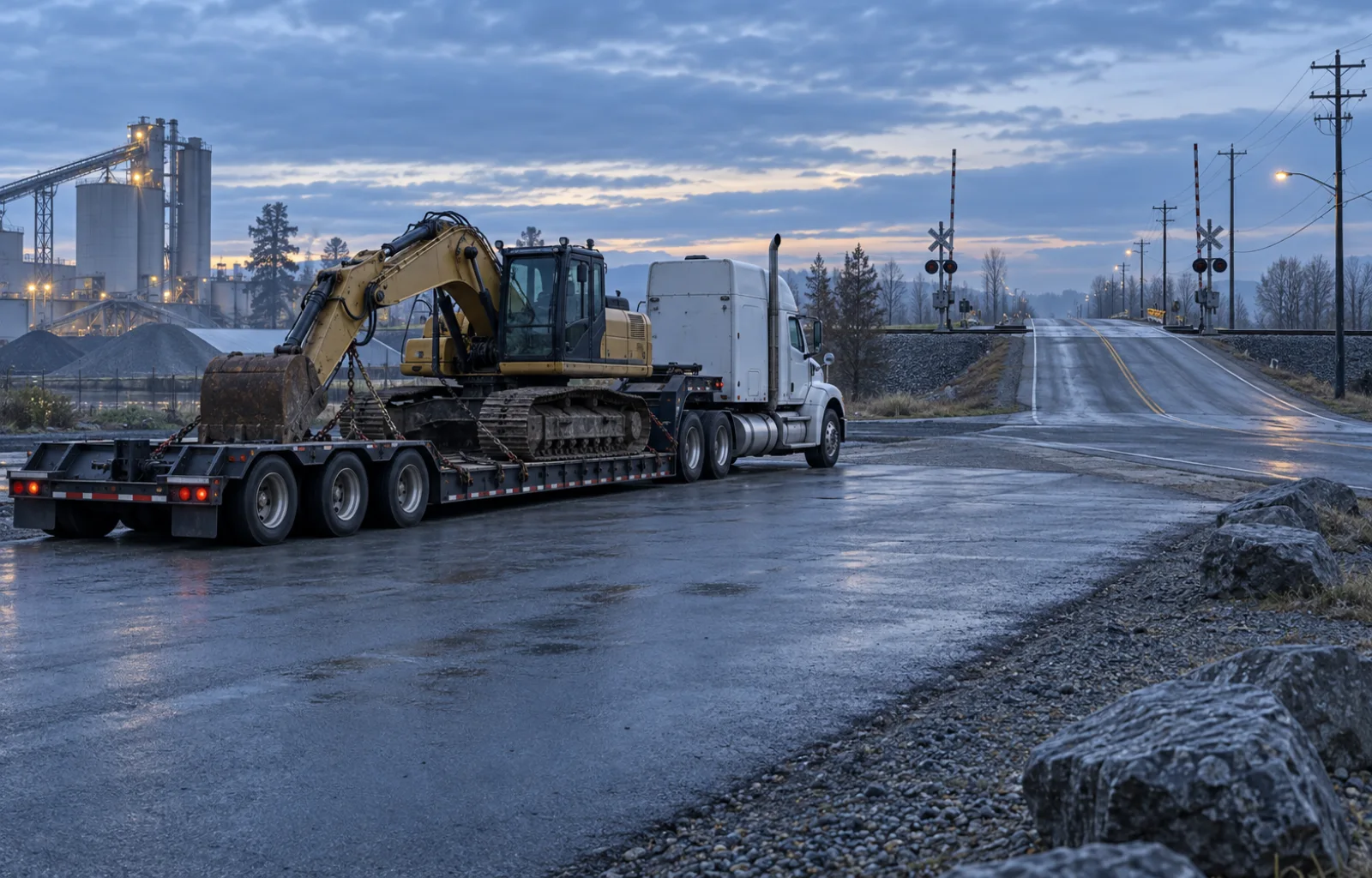
A bridge clearance asks whether the load fits underneath. A raised railroad crossing asks whether the trailer can get over the road itself. Those are different measurements, and a route that answers the first question can leave the second unresolved. For a low equipment trailer, the dangerous point may be the pavement under its middle rather than anything above its cargo. This practical resource examines current federal guidance, checked September 27, on the crossing profile that should be understood before a permitted load reaches the rails. It reports no new crash or new rule.
Federal Motor Carrier Safety Administration guidance singles out long-wheelbase vehicles, low-ground-clearance rigs and loads requiring special weight or dimension permits for extra precautions. The agency also says many states require advance railroad notification for slow-moving or low-clearance movements. On a private crossing, it calls for coordination with both the landowner and railroad. Permission to use a route therefore belongs alongside a physical crossing assessment and any required coordination. It is not evidence that an unfamiliar hump will fit the actual trailer.
The Federal Highway Administration’s pilot-and-escort guidance explains why the hump exists: tracks are built up for drainage, and the roadway can change elevation abruptly as it crosses them. Low vehicles may become stuck at that transition. In plain mechanical terms, the wheels can be supported on opposite sides of a crest while the underside meets the higher pavement between them. Ground clearance measured on level ground and the spacing between supporting axles need to be considered together. That explanation is editorial synthesis of the guidance, not a formula certifying any particular trailer.
A useful crossing assessment looks at the whole shape, not only the rails. FHWA’s trip-operations training asks about the upward approach slope, the downward departure slope, the length of the top or number of tracks, and whether either side requires a turn or follows a curve. It also asks what advance notification the railroad requires. These questions explain why a photo of the crossing or a navigation pin is incomplete: neither establishes how the loaded combination will sit as it climbs, passes the crest and descends.
The law-enforcement escort guidelines add a measurement check. They call for verifying the ground clearance stated in the permit and, when included in its details, the wheelbase. They say clearance must be sufficient for the crossings expected along the entire route and that those crossings should be addressed in the route survey. The practical implication is to give the surveyor the actual vehicle configuration, then reconcile the measurements and crossing assessment before movement. A measurement from a different trailer is not a sound basis for this decision.
Industry sponsor Built for carriers that want one operational view.
Meet Pro FleetSync ↗
Built for carriers that want one operational view.
Meet Pro FleetSync ↗
There is a separate problem on the far side: room to finish. FHWA’s route-planning manual tells surveyors to examine nearby intersections, traffic-signal timing and the distance from tracks to stop signs or signals. A long vehicle may cross the hump successfully but still be trapped by a queue before its rear clears the rails. FMCSA’s safe-clearance guidance prohibits covered commercial drivers from entering unless there is room to drive completely through without stopping. Physical fit and exit space are separate checks; neither substitutes for obeying the crossing’s warnings.
The risk extends beyond heavy-haul trucking. In the NTSB’s completed investigation of a March 2017 Biloxi motorcoach crash, the bus grounded at a high-profile crossing that had a low-ground-clearance warning sign. The lights and gate were not active when it entered. A freight train subsequently struck the stuck coach, killing four passengers. NTSB attributed the probable cause to the railroad and city’s failure to coordinate and improve a crossing where vehicles were known to ground, with inadequate federal mitigation guidance contributing. This historical investigation illustrates a road-design hazard; it is not a report of a September 2026 event.
For today’s trip, the most useful pause comes while the load can still wait safely away from the crossing. MilesNews editorial guidance is to identify a suitable staging point, settle the crossing assessment and required contacts, and make sure driver and escorts know which unresolved condition stops movement. If the permitted route becomes unsuitable, involve the permit authority and responsible railroad rather than improvising another road. For customers, that verification belongs in the delivery plan: a later arrival agreed before departure is easier to manage than a load immobilized on tracks.
Emergency preparation needs an exact location as well as a phone. FRA’s blue-and-white Emergency Notification System sign supplies the responsible railroad’s emergency number and the national crossing identification number. FRA instructs callers to give that identifier and describe the problem. FHWA’s escort guidance calls for identifying emergency contacts and the person who will initiate the call. If a vehicle becomes lodged, FHWA’s training puts evacuation and moving away from the tracks first, followed by immediate railroad notification; use 911 if the railroad number cannot be located. Do not wait for a visible train to treat the blockage as an emergency.
For other road users, the same crossing deserves space. Queuing onto the tracks behind a slow load can turn one vehicle’s problem into several. The national lesson is a concrete one: the route must accommodate the bottom of the vehicle, the entire combination beyond the rails, and the people who need to act if either check fails. A permit, a quiet warning system and an open-looking road each answer only part of that question.
Route check
- Assess the crossing’s rise, crest, descent and approach geometry against the actual loaded vehicle’s ground clearance and axle spacing.
- Confirm exit space, permit conditions and any required railroad or landowner coordination before committing to the tracks.
- Keep the crossing identification, railroad emergency contact and caller assignment ready; a lodged vehicle requires immediate action.