
A school-bus stop changes the road before the red lights
Wisconsin's School Transportation Safety Week arrives as familiar routes fill again with buses, students and crossing guards. The safest adjustment begins before a driver reaches the flashing lights.
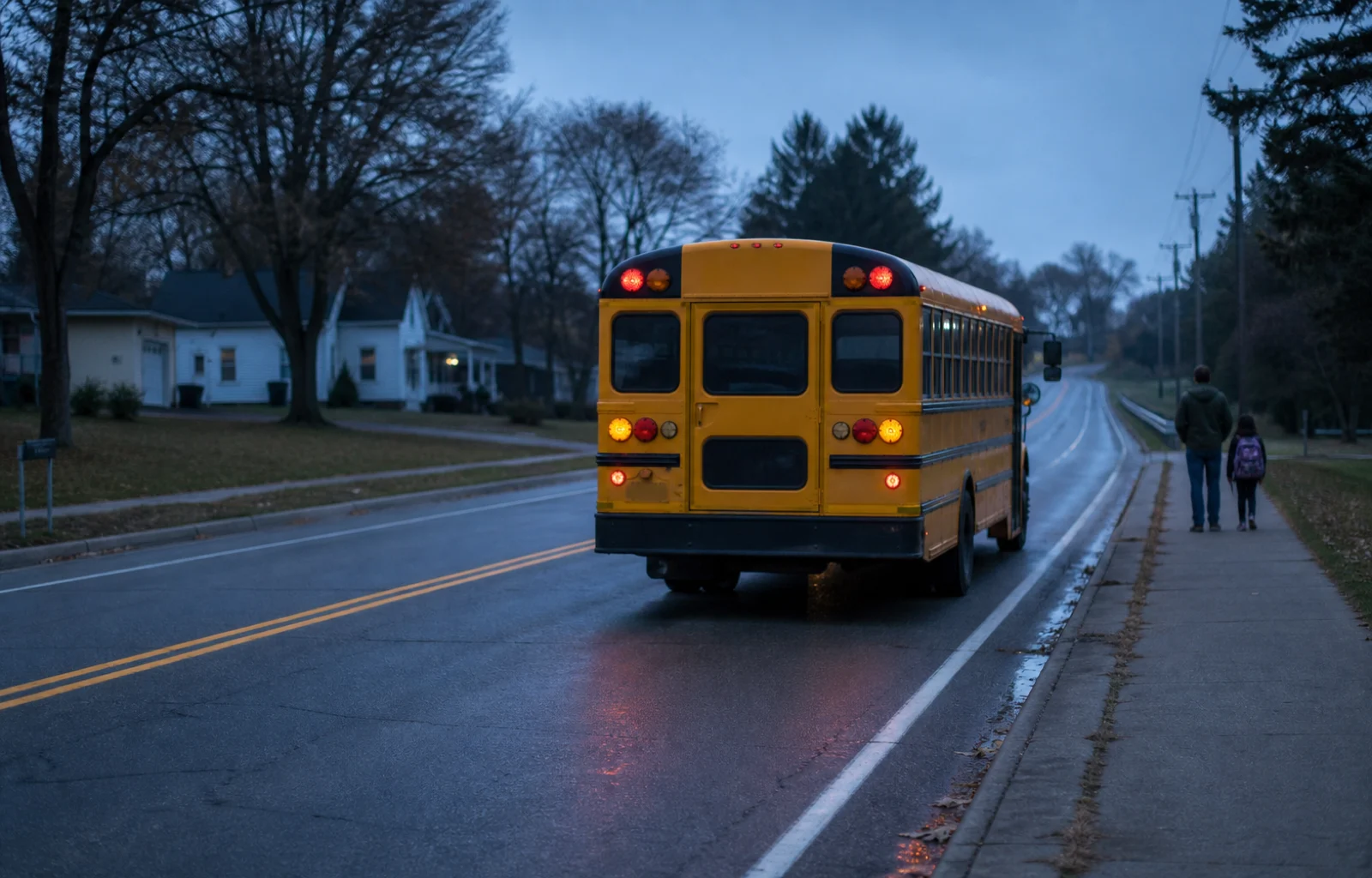
The yellow bus is only the most visible part of a school route returning to the road. Wisconsin's Department of Transportation and Department of Public Instruction are marking August 17 through 21 as School Transportation Safety Week, with daily attention to crossing guards, bus stops, school zones, driving near buses and pedestrian safety. For everyone else on the route, that calendar is an early warning that the street may work differently than it did last week.
A bus stop changes the road before the bus fully stops. The National Highway Traffic Safety Administration says flashing yellow lights mean a school bus is preparing to load or unload children, so motorists should slow down and prepare to stop. Flashing red lights and an extended stop arm mean the bus has stopped for boarding or unloading. Drivers must wait until the red lights stop, the arm withdraws and the bus starts moving before proceeding.
The surrounding space matters as much as the signal. NHTSA says children face more risk while approaching or leaving a bus than while riding inside it. A child may be waiting out of a driver's direct view, walking toward the curb or crossing after the door opens. The useful scan therefore includes the sidewalk, driveway and far side of the street, not only the rear of the bus.
Wisconsin's rule adds a local detail: a vehicle approaching a stopped school bus with flashing red warning lights must stop at least 20 feet away and remain stopped until the bus moves or the lights are turned off. The state provides an exception for opposing traffic on a divided highway. Rules for opposing traffic and what counts as a divided roadway vary by state, so the safe trip brief is to know the law where the trip actually runs rather than carry one remembered exception across state lines.
Industry sponsor Keep every mile and every document connected.
Take a closer look ↗
Keep every mile and every document connected.
Take a closer look ↗

Families have a matching decision before the wheels arrive. NHTSA recommends that children wait at least 10 feet, or five giant steps, from the curb, approach only after the bus stops and the driver signals that it is safe, and never walk behind the bus. If something is dropped near the vehicle, the child should tell the driver rather than move back into an area the driver may not see.
For commuters, service crews and delivery drivers, the first week of a route can also change timing. A stop that was absent during summer can add a pause, and a school-zone crossing can put more people near a turn or driveway. Any broader delay is an editorial inference, not an agency forecast; the point is to leave enough margin that a normal stop does not become a reason to rush through the next intersection.
A practical morning reset takes less than a minute. Expect buses on roads that feed neighborhoods and schools, clear the windshield and mirrors before moving, put the phone away, and treat a crossing guard's direction as part of the traffic control. Work vehicles should secure loose items before departure so attention is not pulled inside the cab when the route reaches a bus stop.
The red lights are the final instruction, not the first clue. A waiting family, a crossing guard, a reduced school-zone speed and a bus easing toward the curb all describe the same road condition. Seeing those pieces early gives every traveler more time to slow down, stop predictably and let the school day begin without turning an ordinary route into a close call.
Route check
- Treat yellow school-bus lights as the cue to slow down and prepare to stop.
- Scan the sidewalk and both sides of the road for children near a bus stop.
- Check the school-bus stopping law in the state where the trip runs, especially for divided roads.