
A snowplow’s working width can hide in the spray
The truck body does not show the whole clearing operation. Wing blades, steerable trailers and staggered plows explain why a tempting opening can be working space.
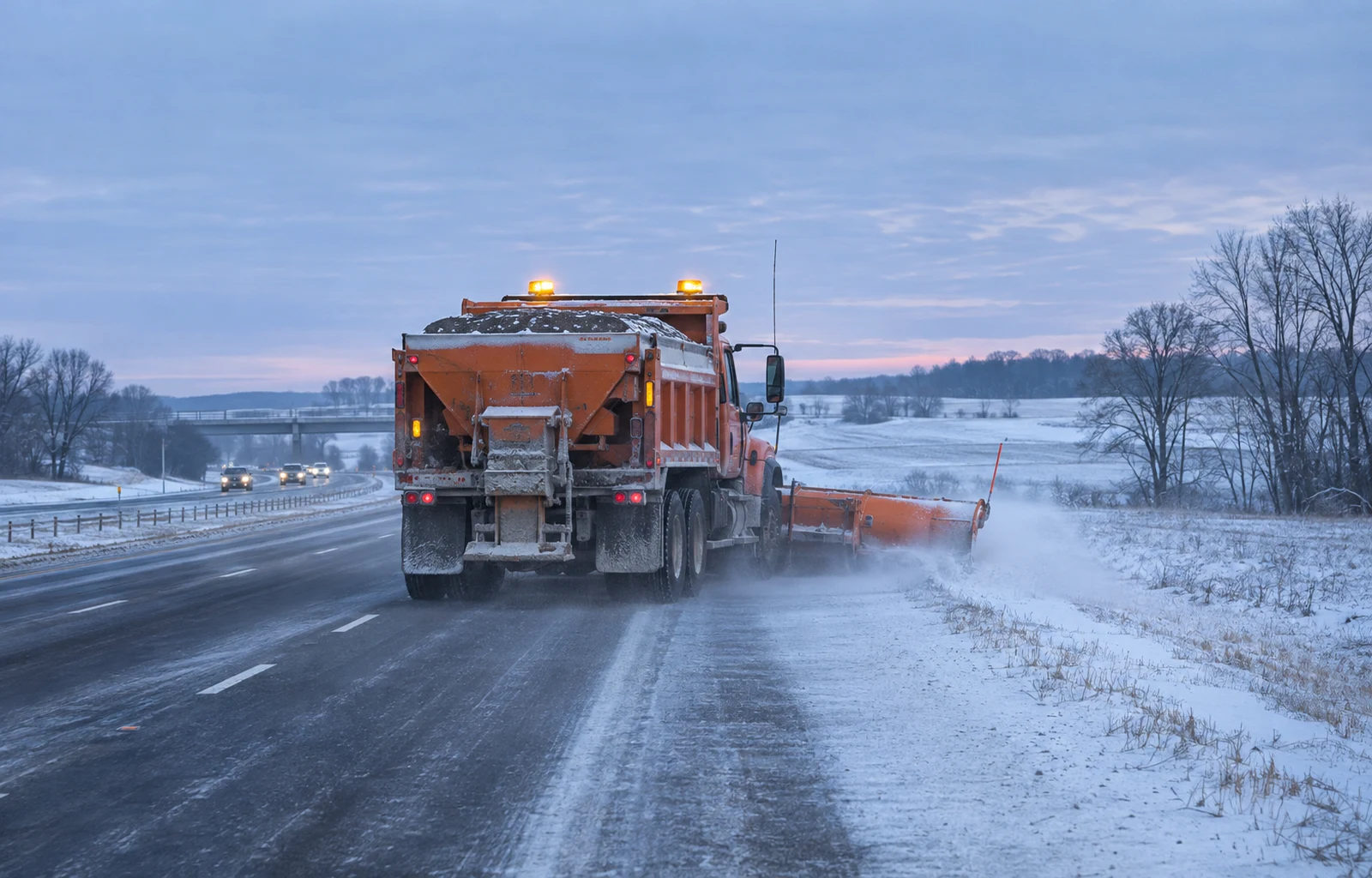
An orange truck ahead looks narrow enough to pass. Near the pavement, however, its working equipment may reach beyond the body a driver can see. That mismatch matters to a tractor-trailer trying to complete a delivery and to a family following the same winter road. This resource examines existing state-agency guidance checked November 4; it is not a storm forecast or a report of a new crash. The useful question is what occupies the apparent opening beside a working plow, and what a driver gives up by moving into it.
Iowa DOT’s January 2025 explanation distinguishes two kinds of extra width. A wing blade attaches to the truck and can reach toward a shoulder or neighboring lane, where blowing snow makes it hard to notice near pavement level. A towplow is a separate steerable plowing trailer that can reach beyond a normal lane. Nebraska DOT likewise explains that its towplow swings outward hydraulically so one truck can clear two lanes. The visible truck is therefore only part of the equipment to account for. An empty-looking strip next to its rear wheels does not establish a usable passing lane.
The snow itself can hide that working space. Minnesota DOT tells drivers not to enter a snow cloud and recommends staying at least 10 car lengths behind a plow. Wisconsin DOT gives its own guidance of at least 200 feet behind a working plow, warning that conditions ahead are likely worse. Those are agency recommendations, not a universal stopping-distance calculation for a loaded truck. MilesNews’s practical interpretation is to leave more room when visibility, traction or the vehicle requires it; reaching a stated distance does not make a blinded approach safe.
Several trucks spread across a highway can also be one coordinated operation. Connecticut DOT’s winter FAQ calls this close echelon plowing: the trucks are arranged to prevent traffic passing through ridges of displaced snow between them. What appears to be a gap in a slow queue can be part of the clearing pattern. The agency says staying behind the trucks during major snow events is the safer position. That explanation transfers beyond Connecticut: the opening between working vehicles should not be assumed to be a lane offered to through traffic.
Industry sponsor Keep every mile and every document connected.
Take a closer look ↗
Passing guidance needs its local context. Nebraska says never to pass a plow on the right and warns against passing in a snow cloud or before the road ahead is known to be clear. Iowa warns against passing on the shoulder side, lingering alongside, or cutting back in too soon; packed snow can push a plow sideways. These are reasons to wait, not a checklist promising that a pass will be safe. This resource does not assert a nationwide passing law. Follow applicable signs and local rules, and give the operator room to work rather than trying to squeeze past hidden equipment.
The preparation starts before closing on the flashing lights. Nebraska advises beginning to slow when a plow comes into view and notes that operators may turn around at ramps or authorized median crossovers. Minnesota also warns of frequent turns and exits. For a delivery business, MilesNews recommends treating time behind clearing equipment as a reason to revise an arrival estimate from a safe stopping place. A customer can plan around an updated window; an attempt to recover minutes beside a blade creates a different problem for everyone sharing the road.
Behind the plow still means winter driving. Wisconsin urges drivers to check 511 conditions before departure, allow extra time and following distance, and remember that posted speeds assume ideal conditions. The strip already treated is not a promise of dry pavement. For today’s planning, know where the route’s condition reports are and leave room in the schedule for a slower clearing operation. On the road, the central distinction is simple: the outline of the truck and the space needed to do its work are different sizes.
Route check
- Leave space for hidden wing blades, towplows and the full clearing operation.
- Stay out of snow clouds and avoid gaps between coordinated working plows.
- Check local conditions and passing rules; allow extra time behind snow-removal equipment.