
A trailer tug test still needs a look at the lock
The pull check and the visual inspection answer different questions. Before a trailer leaves the yard, the driver needs to verify the connection that everyone on the road will depend on.
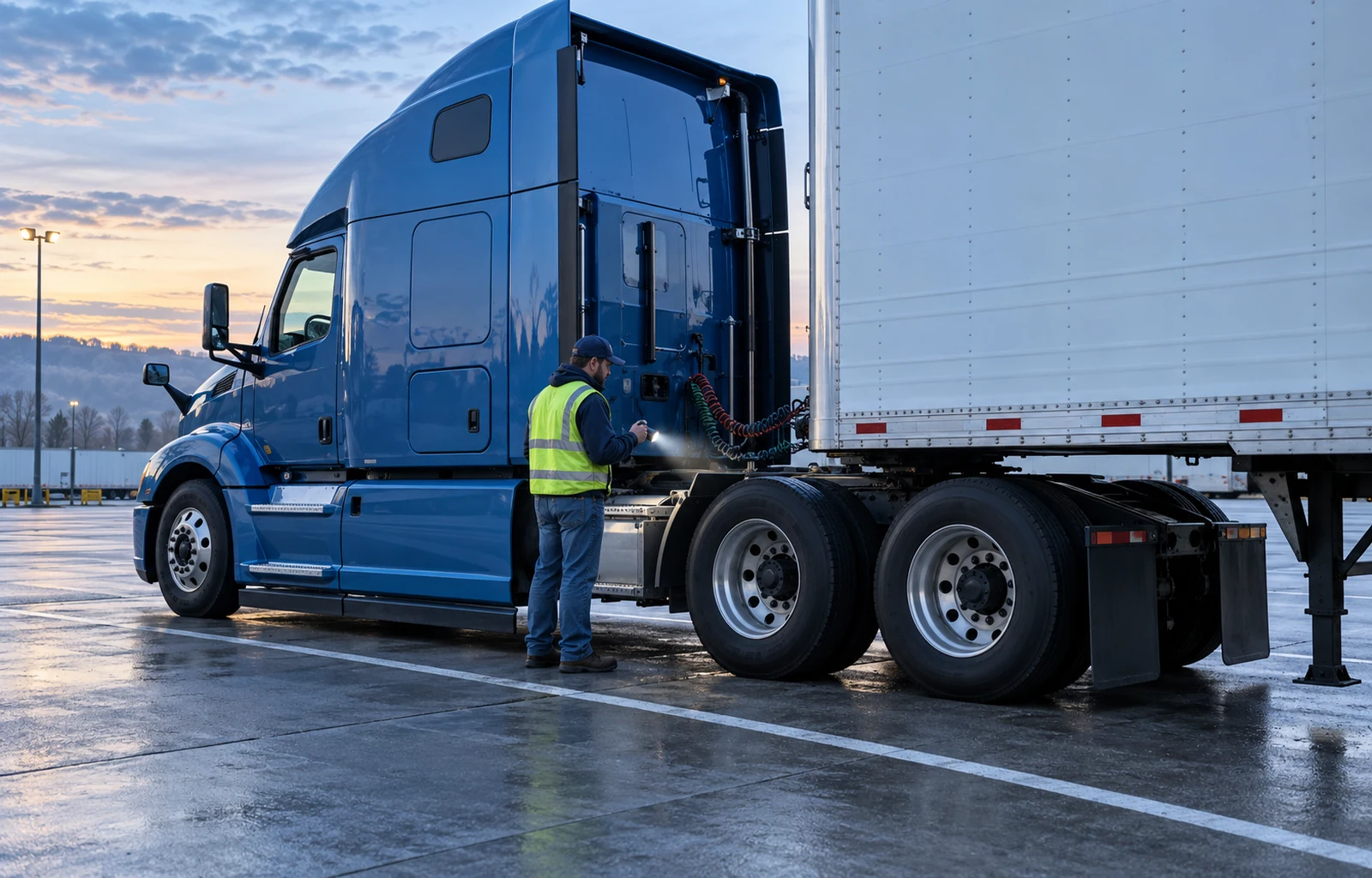
A trailer pickup has a quiet moment between the connection and the gate. The tractor has backed beneath the trailer, the driver has checked the coupling with a gentle pull, and the next appointment is waiting. What still needs a look? This vehicle-care resource, checked against federal requirements and current state CDL manuals on September 30, explains why the tug test does not finish the coupling inspection. It reports no new crash, recall or rule. The question matters wherever a tractor changes trailers, because the connection will soon share a public road with people who cannot see it.
The federal starting point is the condition of the equipment. FMCSA’s Safety Planner identifies coupling devices among the parts a driver must be satisfied are in good working order before driving. Section 393.70 separately requires a fifth-wheel locking mechanism that prevents separation unless a positive manual release is activated; readily separable fifth-wheel locks must engage automatically when coupling. A trailer number, a dispatch release or the fact that the tractor and trailer moved together does not show the position of that mechanism. Those are useful records or observations, but they answer a different question.
Oregon’s commercial-driver manual puts a gentle pull check before a separate visual coupling inspection. Its sequence then calls for securing the vehicle, including parking brakes, neutral, engine off and taking the key, before inspecting the connection. The visual checks include no space between the upper and lower fifth wheel, jaws closed around the kingpin’s shank, the locking lever in position and the safety latch set. The manual warns that a gap can mean the kingpin is resting above closed jaws, allowing an easy separation. Its instruction for an incorrect coupling is to stop the move and have it fixed.
The vocabulary helps make the check concrete. The kingpin projects beneath the trailer; the apron is the plate that rests on the tractor’s fifth wheel. California’s CDL handbook describes jaws around the shank rather than the head of the kingpin, along with a seated release arm and engaged safety latch or lock. That distinction is why a driver needs to verify the actual connection, not just remember the sound or feel of backing under the trailer. The coupling procedure for the particular rig still governs; familiarity with one fifth wheel does not establish the details of another.
Industry sponsor Keep every mile and every document connected.
Take a closer look ↗
Keep every mile and every document connected.
Take a closer look ↗
The surrounding equipment remains part of the departure decision. Oregon’s vehicle-inspection section checks for damaged or worn kingpins, an apron lying flat on the skid plate, engaged sliding-fifth-wheel pins and secure release devices. It also addresses air and electrical lines: connections should be seated, lines undamaged and routed without pinching or dragging. These checks serve different purposes. A locked kingpin does not establish that the trailer can receive brake air or display its signals, just as an electrical connection does not establish a secure mechanical lock.
MilesNews analysis: a useful yard handoff leaves time for both kinds of verification. If the visual check reveals a gap, questionable lock position or damage, the exception needs an equipment response before an arrival estimate. That makes the inspection interval an operating commitment for the business sending the truck, not merely a few spare seconds the driver must find. A substitute tractor or a repaired connection can change the schedule; allowing uncertainty through the gate moves that same uncertainty onto the road. This is an interpretation of the inspection guidance, not a claim about how often trailer separations occur.
For other road users, the relevance is simple: the hidden connection is part of the safety of the visible truck. Families beside a trailer and businesses waiting for its load rely on work performed before departure. For the driver, the practical finish line is equally clear. Carry out the pull check and the secured visual inspection using the correct equipment procedure, complete the related line and clearance checks, and resolve an incorrect coupling before driving. The tug provides one piece of evidence. A verified lock provides another; the trip needs both.
Route check
- Treat the gentle pull check and the secured visual coupling inspection as separate steps.
- Verify the kingpin engagement, plate contact and locking devices using the procedure for that rig; resolve an incorrect connection before driving.
- Leave time for air, electrical, sliding-lock and clearance checks before the yard release.