
Carrying a fire extinguisher does not settle the escape plan
Federal truck rules specify the equipment. Fire-safety guidance answers a separate question: how people get away when a vehicle burns. This resource connects both checks before the trip.
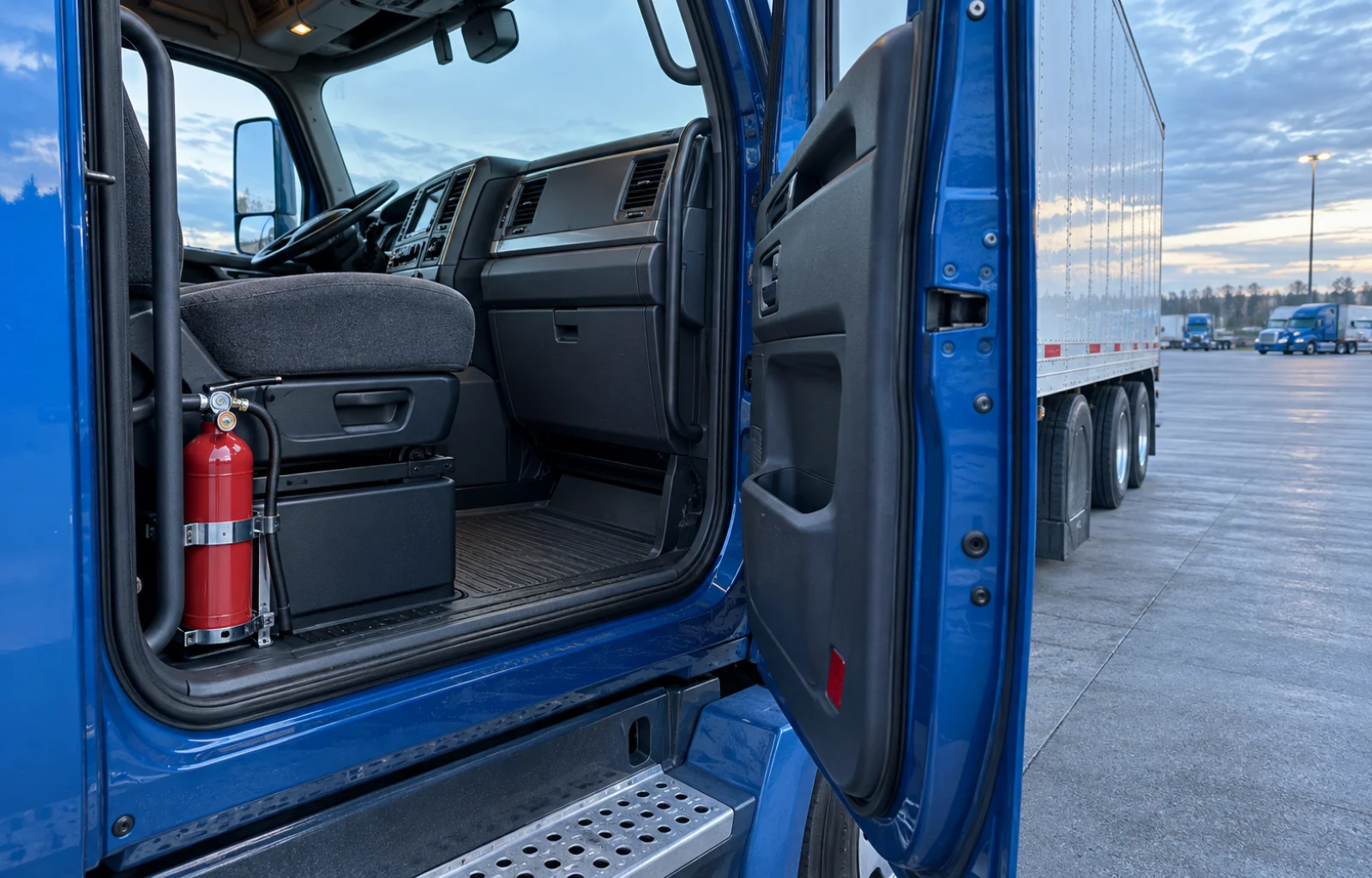
An extinguisher mounted beside a truck seat can be familiar enough to disappear into the background. Its presence answers only part of the preparedness question. Before a trip, someone still has to establish whether the equipment meets the applicable requirement, whether its condition can be checked and whether the people aboard know how to leave. This resource uses federal sources verified October 9 to connect equipment readiness with an escape plan. It reports no new fire or rule. The question matters beyond trucking: passengers, nearby motorists and customers can all be affected when a vehicle stops burning beside a road.
For operations covered by the federal equipment rule, Section 393.95 requires a power unit carrying hazardous materials in quantities requiring placards to have an extinguisher rated at least 10 B:C by Underwriters Laboratories. For a power unit not transporting hazardous materials, it specifies one rated at least 5 B:C, or two each rated at least 4 B:C. The manufacturer must mark the rating. The section contains driveaway-towaway exceptions; those operations need their own applicability check. A cylinder's size or color is not the rating. MilesNews editorial advice: have the carrier confirm the correct equipment against the actual operation before departure, rather than deciding from appearance.
The rule also requires a way to visually determine full charge, a filled extinguisher, ready access and secure mounting against movement. FMCSA's published interpretation clarifies a useful detail: a pressure gauge is not the only acceptable visual means. Editorially, that makes the check specific to the installed unit. Learn its manufacturer's indicator and service instructions; do not declare a gauge-free unit defective merely because another truck has a dial, or assume any red cylinder is ready. Bags and loose cab supplies should not turn the route to the extinguisher or the doorway into a search. Review condition and access together while parked.
Industry sponsor Run the whole trip in one connected TMS.
See it in action ↗
Run the whole trip in one connected TMS.
See it in action ↗
Once a vehicle is burning, the U.S. Fire Administration gives the public a clear sequence. Stop as soon as it is safe, shut off the engine, get everyone out and stay out. Move at least 100 feet away and clear of traffic, then call 911. The agency advises people not to fight a vehicle fire themselves and not to open a hood or trunk suspected of containing fire, because that can intensify it. Its vehicle-fire guidance is a public evacuation message, not a truck-equipment exemption. Having the required extinguisher aboard does not make returning to a burning cab a safe choice.
OSHA's workplace extinguisher guidance addresses a different setting: employee response to a small, developing fire under an employer's arrangements. It calls for education on extinguisher use and its hazards, and training for designated users. It says to identify an evacuation route before approaching, keep heat and smoke from blocking that route, and leave immediately if the fire grows beyond its beginning stage or an emptied extinguisher has not put it out. Doubt about the ability to fight the fire is a reason to evacuate. This workplace guidance is not blanket permission to attack a burning truck; applicability and the employer's procedures must be established separately.
A practical carrier briefing can join those questions without asking a driver to invent a fire plan at the roadside. MilesNews editorial advice is to show the actual extinguisher and its charge indicator, explain who is trained and authorized for any limited use, and rehearse how every occupant exits and reaches a place away from the vehicle and traffic. Dispatch can manage customer and recovery calls after the emergency notification. People passing the scene should leave response work to emergency services rather than gathering beside the truck. Saving a delivery schedule should never become the purpose of returning toward fire.
The useful test is whether the plan still works when the extinguisher cannot be reached safely. A label, an indicator and a sound bracket establish equipment facts before departure. They cannot promise that a developing fire will remain small, that the doorway will stay available or that the cargo presents an ordinary hazard. Keeping the escape decision explicit gives the equipment a defined place in preparation while preserving the priority that matters to everyone sharing the road: people getting out, moving away and summoning help. The cylinder belongs in the check; it should not become a reason to delay leaving.
Route check
- Confirm the rating for the actual operation, full-charge indication, ready access and secure mounting before departure.
- A pressure gauge is one possible charge indicator; FMCSA does not require it as the only visual method.
- For a burning vehicle, USFA directs occupants to exit, stay out, move at least 100 feet away and clear of traffic, and call 911.