
The cab can clear a corner before the trailer does
At a slow truck turn, the space beside the trailer can disappear. Understanding the different paths of the front and rear wheels helps motorists, drivers and delivery sites share the same corner.
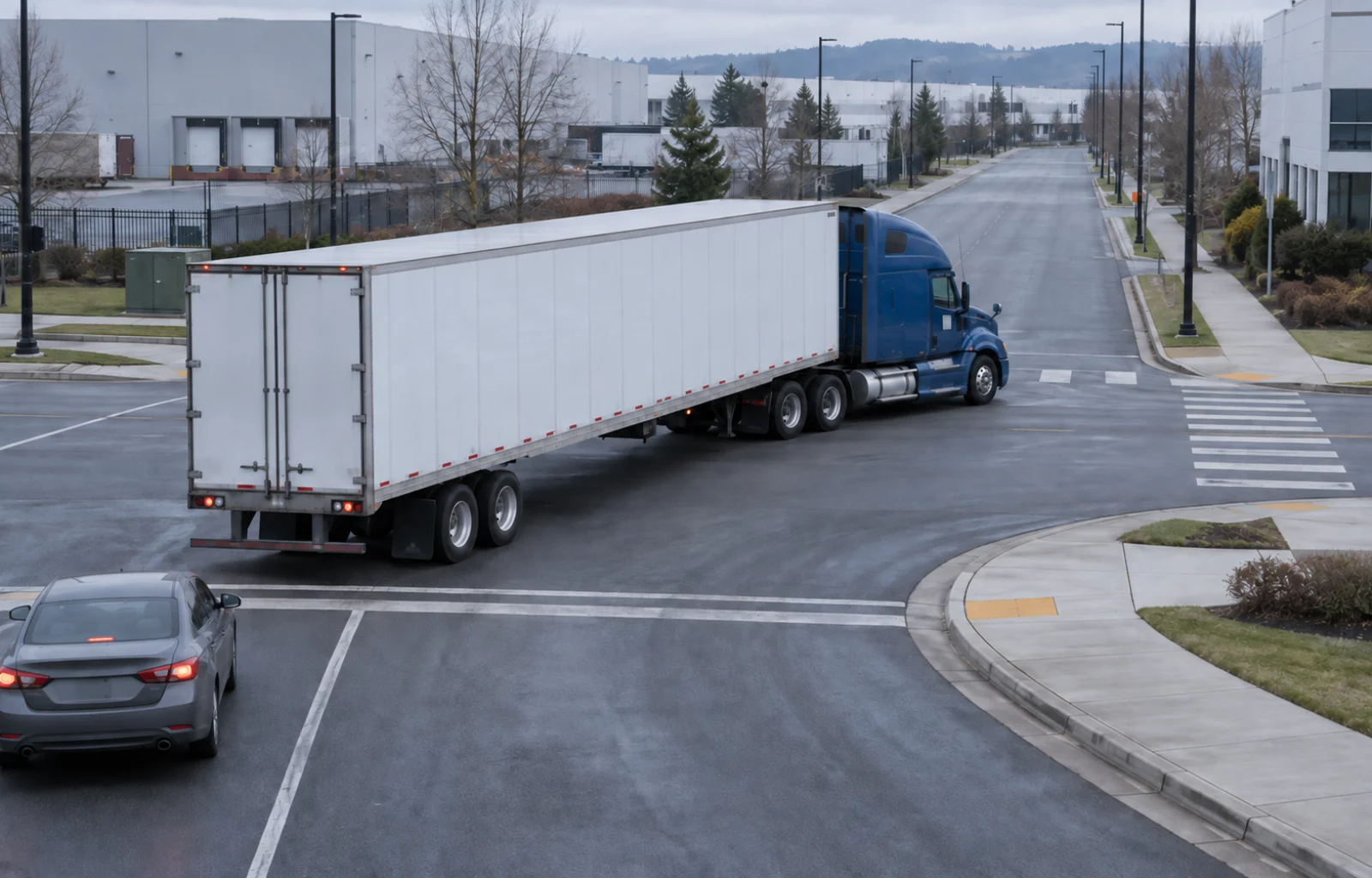
An opening beside a turning truck can look like a way through. The cab has moved ahead, the trailer is still crossing the intersection, and the curb appears a car-width away. The useful question is what that space will look like a moment later. This shared-road resource explains low-speed turning geometry using federal road-safety guidance and Oregon’s commercial-driver manual, checked on October 1. The lesson applies at delivery entrances and ordinary intersections across the country: the front of the truck passing a point does not mean the rest of the vehicle has cleared it.
Oregon’s combination-vehicle manual calls the difference between the front and rear wheel paths off-tracking. In a turn, the rear wheels do not simply retrace the front wheels’ route. Longer vehicles off-track more, and a trailer’s rear wheels off-track more than the tractor’s. That is the physical reason to watch the whole combination rather than only the blue or white cab at its front. The inside of the turning path can consume pavement that looked open before the trailer reached it.
FMCSA’s advice to passenger-vehicle drivers is to wait for a large vehicle to finish turning. Its guidance specifically warns that a truck making a right turn may first move left to obtain enough room. For the person behind, that movement should not be read as an invitation to advance along the truck’s right side. The safe opportunity comes after the maneuver is complete and the route is clear, rather than during a temporary gap. This is a reading of the agency’s wide-turn guidance, not a claim that every intersection requires the same maneuver.
The professional driver has a different task: manage that moving space without making the turn harder for others to understand. Oregon’s general-driving section calls for slow right turns and warns against swinging left at the start, which can tempt a following driver to pass on the right. It also directs drivers to use their mirrors during turns to check the rear of the vehicle. The public warning about what a truck might do and the driver-training advice about avoiding a misleading setup serve different audiences. Neither gives permission to ignore signals, lane restrictions or people crossing the road.
For someone walking or riding near the corner, the practical implication is to stay out of the vehicle’s turning path and avoid treating the cab’s progress as proof that the trailer is clear. This is MilesNews analysis of the geometry, not a transfer of the driver’s responsibility to the person outside the truck. A visible person still needs protection from the moving vehicle; eye contact alone cannot change where the rear wheels will travel. Drivers must account for the complete turn, including the curb and crossing area.
Industry sponsor Built for carriers that want one operational view.
Meet Pro FleetSync ↗
Built for carriers that want one operational view.
Meet Pro FleetSync ↗
The same issue belongs in road design. FHWA’s Road Diet Informational Guide tells practitioners to consider the turning radius of the design vehicle at intersections and driveways, and to design pavement markings and corner radii together for its movements. A design vehicle is the vehicle configuration used to test the layout. That engineering question is more specific than whether a street looks wide: can the intended vehicle make the intended turn through the available space? MilesNews analysis: a business receiving deliveries can turn that question into a useful access check. Identify the truck entrance and expected equipment, and refer a repeated tight-turn problem to the carrier and the people responsible for the site or road. A map pin or a photograph showing a cab through the gate is incomplete evidence of trailer clearance. Temporary storage, parked vehicles or changed access arrangements deserve review before the next delivery, rather than an assumption that the driver can recreate yesterday’s path.
For the motorist, the takeaway is a patient pause behind the turning vehicle. For the truck driver, it is a controlled maneuver that accounts for the rear as well as the front. For the delivery site, it is an approach that works for the actual equipment. These are three views of the same corner. Leaving the truck room until the complete combination is clear protects both the trip and the people who share its last few yards.
Route check
- Wait for the entire truck to finish its turn; a temporary curbside gap can close as the trailer follows.
- Use the correct slow-turn procedure and check rear clearance throughout the maneuver.
- Review delivery access for the actual vehicle configuration, including its trailer path.