
The first roadside ten minutes still belong to visibility
FMCSA removed an obsolete flare from the federal rule this year. The current text still starts with immediate flashers, a ten-minute deadline and warning-device placement that changes with the road.

A disabled commercial vehicle creates two different roadside jobs. The first is making the truck visible before approaching traffic runs out of time. The second is arranging the repair, tow or safe return to the route. Federal rules put a short clock on the first job, and a 2026 change makes it worth checking what the current rule actually says instead of relying on an old equipment list. The change removed an obsolete kind of flare. It did not turn hazard lights into a substitute for external warning devices, and it did not erase the ten-minute deadline.
The Federal Motor Carrier Safety Administration's final rule took effect March 23. It removed references to liquid-burning flares from Parts 392 and 393 because the agency said those devices are no longer used. FMCSA expected no change in regulated behavior and described the revision as a way to remove confusing, outdated language. That narrow scope matters. The final rule did not create a new electronic-warning mandate, approve every aftermarket light as a replacement, or relax the basic roadside sequence.
Under the current Section 392.22, a commercial motor vehicle stopped on the traveled portion or shoulder for a reason other than a necessary traffic stop must use its hazard warning flashers immediately. The flashers stay on until the required external warning devices are in position, and they are used again while those devices are collected before the vehicle moves. Except where a special rule applies, the devices must be placed as soon as possible and no later than ten minutes after the stop. FMCSA's own safety planner summarizes that same sequence, while directing readers back to the regulation as the controlling text.
The familiar general pattern is not the only pattern. On an ordinary two-way road, the rule calls for one device on the traffic side about 10 feet from the vehicle toward approaching traffic, another about 100 feet toward approaching traffic, and a third about 100 feet in the other direction. On a divided or one-way highway, the pattern looks upstream: one device within 10 feet of the rear and the other two about 100 and 200 feet toward approaching traffic, in the lane or shoulder occupied by the stopped vehicle. Those are federal descriptions, not permission to step into an unsafe traffic path without assessing the actual scene.
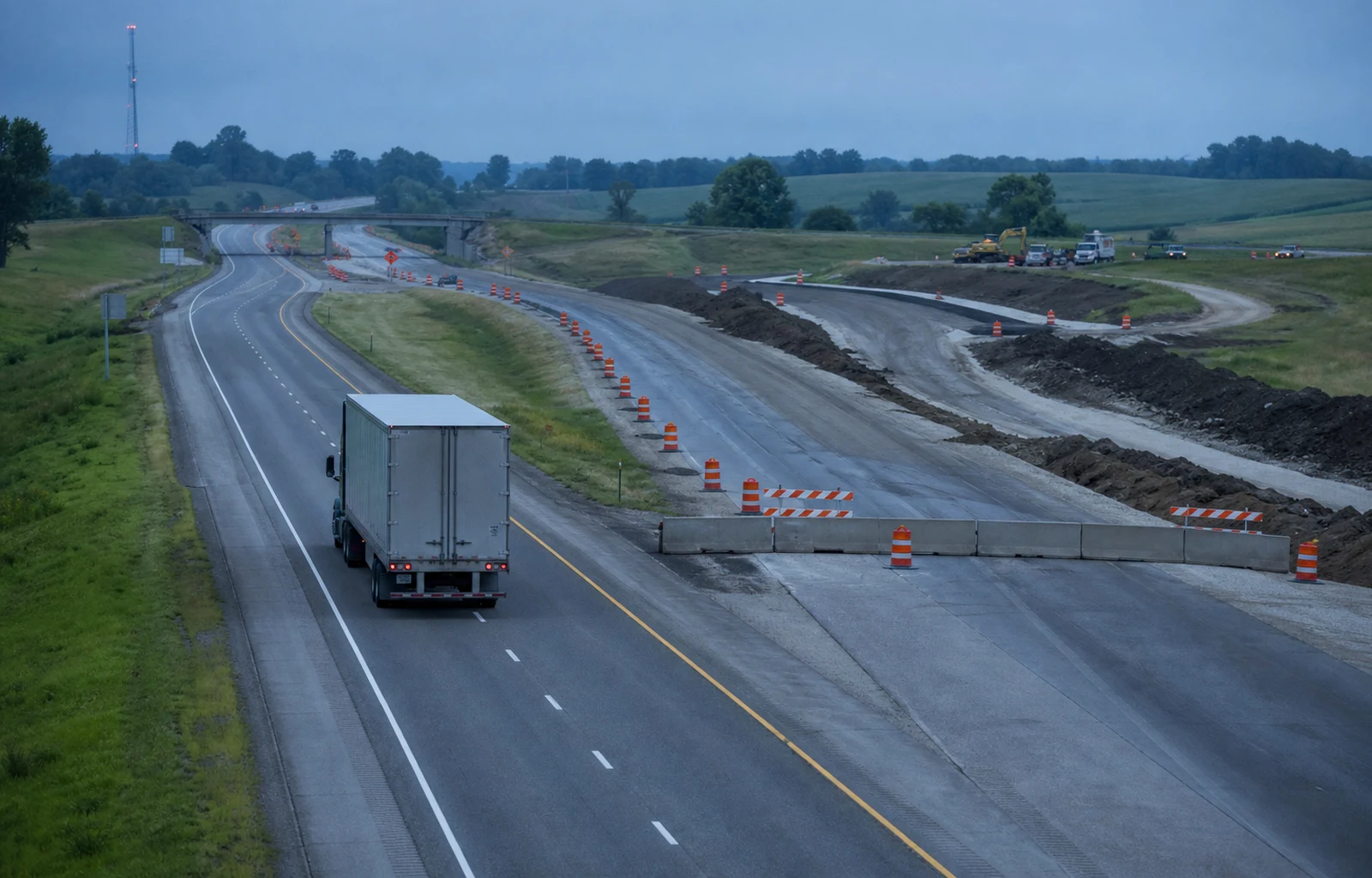
Sight distance changes the plan again. When the vehicle is within 500 feet of a curve, hill crest or another obstruction to view, the warning device in that direction goes 100 to 500 feet away so other road users receive ample warning. The rule also contains a limited business- or residential-district provision tied to whether lamps are required and whether street lighting makes the vehicle clearly visible from 500 feet. A memorized three-number diagram can therefore fail if the driver does not first identify the road type, the direction of approaching traffic and the obstruction that hides the stop.
Industry sponsor From load to settlement, keep it connected.
Follow the workflow ↗
From load to settlement, keep it connected.
Follow the workflow ↗
The equipment rule in Section 393.95 currently lists three conforming bidirectional reflective triangles or at least six fusees, with enough additional fusees to satisfy the placement requirement. Other warning devices may be added, but the text says they cannot replace the required devices. Flame-producing devices also carry restrictions for specified explosives, flammable-gas and flammable-liquid operations and for commercial vehicles using compressed gas as motor fuel. The useful pre-trip question is not simply whether something bright is somewhere in the cab. It is whether the power unit carries an allowed, serviceable set that the driver can reach and use under the equipment and cargo conditions that apply.
That physical task remains important enough to shape future truck technology. FMCSA's current automated-warning-device research page says driverless commercial vehicles cannot, as presently designed, perform the human job of placing roadside devices within ten minutes. The agency's Phase II project is developing and testing a prototype that would deploy markers automatically. The research is not a new compliance option for today's fleet. It is evidence that a stopped vehicle still needs a visible perimeter even when automation changes who—or what—has to create it.
Passing traffic has a separate responsibility. NHTSA says all 50 states have Move Over laws and advises drivers approaching flashing roadside lights to slow promptly, move over when it is safe and leave as much space as possible when a lane change cannot be made. The precise vehicles covered, required speed response and penalties vary by state, so that national advice is not a substitute for the law on the road being traveled. It does show why the stopped-truck plan and the approaching-driver plan belong in the same safety picture: one marks the hazard while the other preserves working room around it.
A practical fleet review can be done before the next shoulder stop. Verify the warning-device type and condition during equipment checks; make sure the set is accessible rather than buried behind freight or loose cab gear; train the difference between two-way and divided-road placement; include curves, hills, darkness, weather, traffic and hazardous-material conditions in scenarios; and give dispatch a clear way to manage the repair and customer calls after the driver reports the exact location. Those steps are MilesNews editorial guidance drawn from the current federal sources, not a replacement for carrier training, scene-specific judgment or legal advice.
This is also why the article does not repeat MilesNews's earlier report on Iowa's Highway Helper program. That story asked which public and private assistance resources a corridor offers after a truck stops. The new question comes first: what signals and physical warning devices must define the roadside scene before the recovery network takes over? A tow plan may shorten the stop. It cannot give approaching traffic back the seconds lost before the truck becomes visible.
The cleanest reading of the 2026 update is deliberately modest. One outdated tool left the federal text; the visibility job remained. Hazard flashers begin the sequence, external devices extend it, road geometry changes it and passing drivers still need space to respond. When a commercial vehicle is stranded beside live traffic, ten minutes is not the repair clock. It is the outside limit on making the stop legible to the road around it.
Route check
- FMCSA removed liquid-burning flares from the federal text effective March 23, 2026; it did not remove the warning-device duty.
- Use flashers immediately, then place the required external devices as soon as possible and within ten minutes when Section 392.22 applies.
- Train placement by road shape and sight distance: divided highways, two-way roads, curves and hills do not use one identical diagram.