
The next truck-parking dollar should follow the driver's clock
The FY 2026 INFRA program puts commercial-vehicle parking in a dedicated funding lane. The useful test is whether new capacity appears where a legal driving day actually runs out.
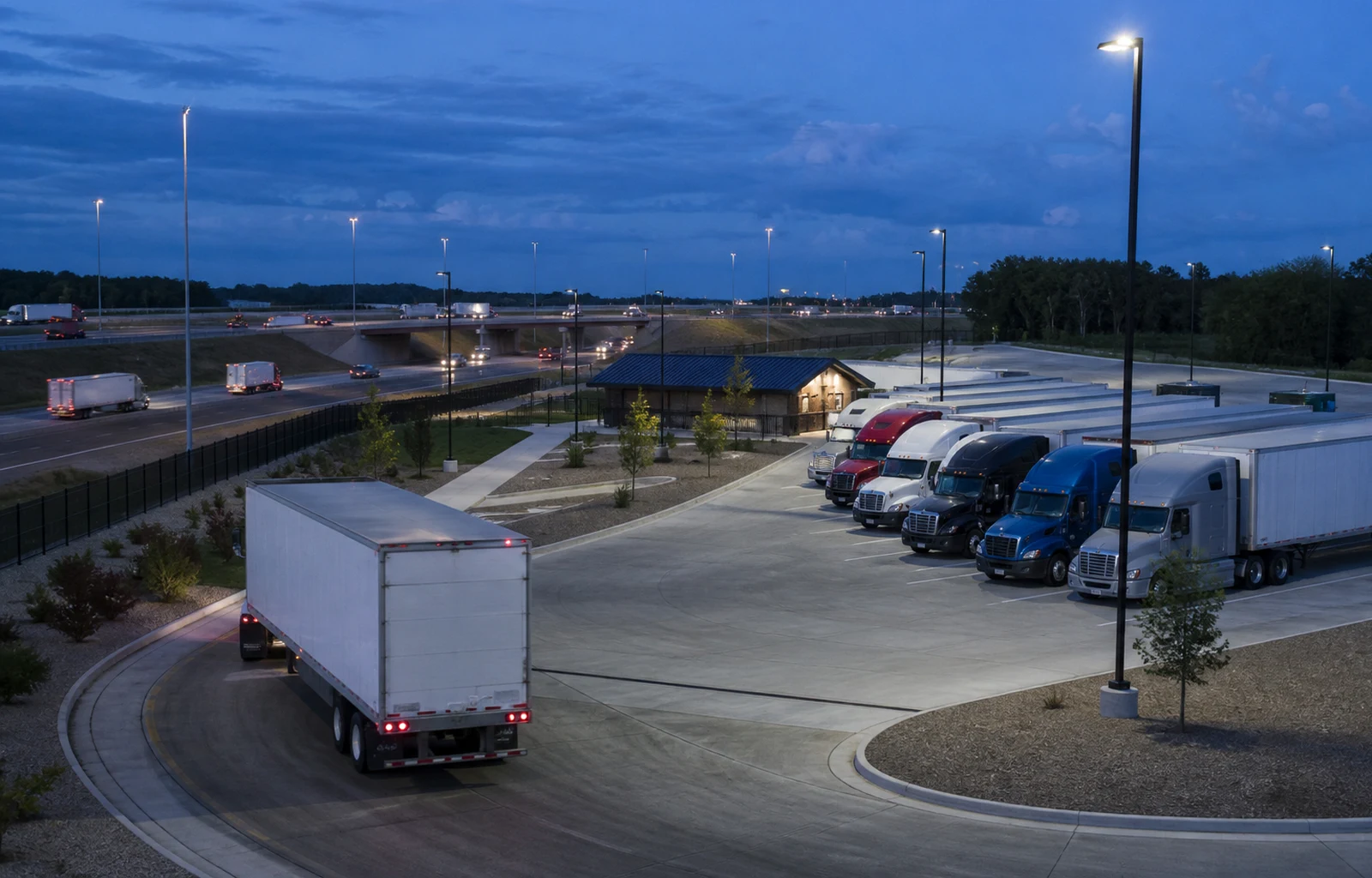
The FY 2026 INFRA grant program gives commercial-motor-vehicle parking unusual prominence. The U.S. Department of Transportation says the current program includes a dedicated $200 million Track 2 for parking projects, alongside a broader preference for projects that expand safe and accessible parking on important freight corridors.
That is a funding story, but for drivers it is really a location story. A new lot can add capacity and still miss the operating problem if it sits beyond the point where a driver commonly runs out of legal time, too far from the receivers that create staging demand, or on the wrong side of a recurring closure.
The best applications should therefore start with the driver's clock rather than a vacant parcel. Useful evidence includes where trucks begin searching, where ramps and shoulders fill after dark, how often a corridor closes, and which delivery windows force early arrival near a customer.
Parking also needs to work as part of a trip. Safe ingress, enough turning radius, lighting, restrooms, reliable information, and a practical path back to the highway all affect whether a space is truly usable. A painted stall that is difficult to enter or impossible to trust does not solve the driver's decision.
Industry sponsor Keep every mile and every document connected.
Take a closer look ↗
Keep every mile and every document connected.
Take a closer look ↗
Dispatchers can help by recording parking exceptions with more precision. Instead of a generic delay code, note the planned stop, the time availability disappeared, the backup attempted, and the extra miles or time required. Those details turn individual frustration into corridor evidence.
Carriers should also separate overnight parking from staging. A driver taking a ten-hour break has different needs from a driver waiting forty minutes for a receiver to open a gate. Treating both as one demand number can produce the wrong site, layout, or operating rules.
The federal notice does not guarantee that every proposed lot will be funded or built. It does, however, give states and corridor groups a clearer reason to put commercial parking into a serious project pipeline rather than leaving it as an accessory to a larger highway job.
For fleet planning, the near-term action is not to assume relief is coming. Keep using verified parking sources, build primary and backup stops into longer trips, and avoid schedules that depend on finding the last open space at the end of the clock.
For public agencies, the opportunity is to show the relationship between capacity and actual trip patterns. A project becomes more convincing when it explains who needs the space, when demand peaks, how drivers receive availability information, and what unsafe parking it is expected to reduce.
A strong parking investment should give a driver more than pavement. It should create a dependable decision point early enough in the trip to protect the clock, the route, and the next day's work.
Route check
- Measure where parking searches begin, not only where trucks finally stop.
- Separate overnight rest demand from customer-staging demand.
- Keep primary and backup parking in the route plan while projects remain proposals.