
The rear-guard award starts with the build date
IIHS has added Fruehauf dry vans to its Toughguard list, but only for a defined production window. The useful safety check separates a federal minimum, a tougher corner-overlap test, and the condition of the guard that is actually on the road.
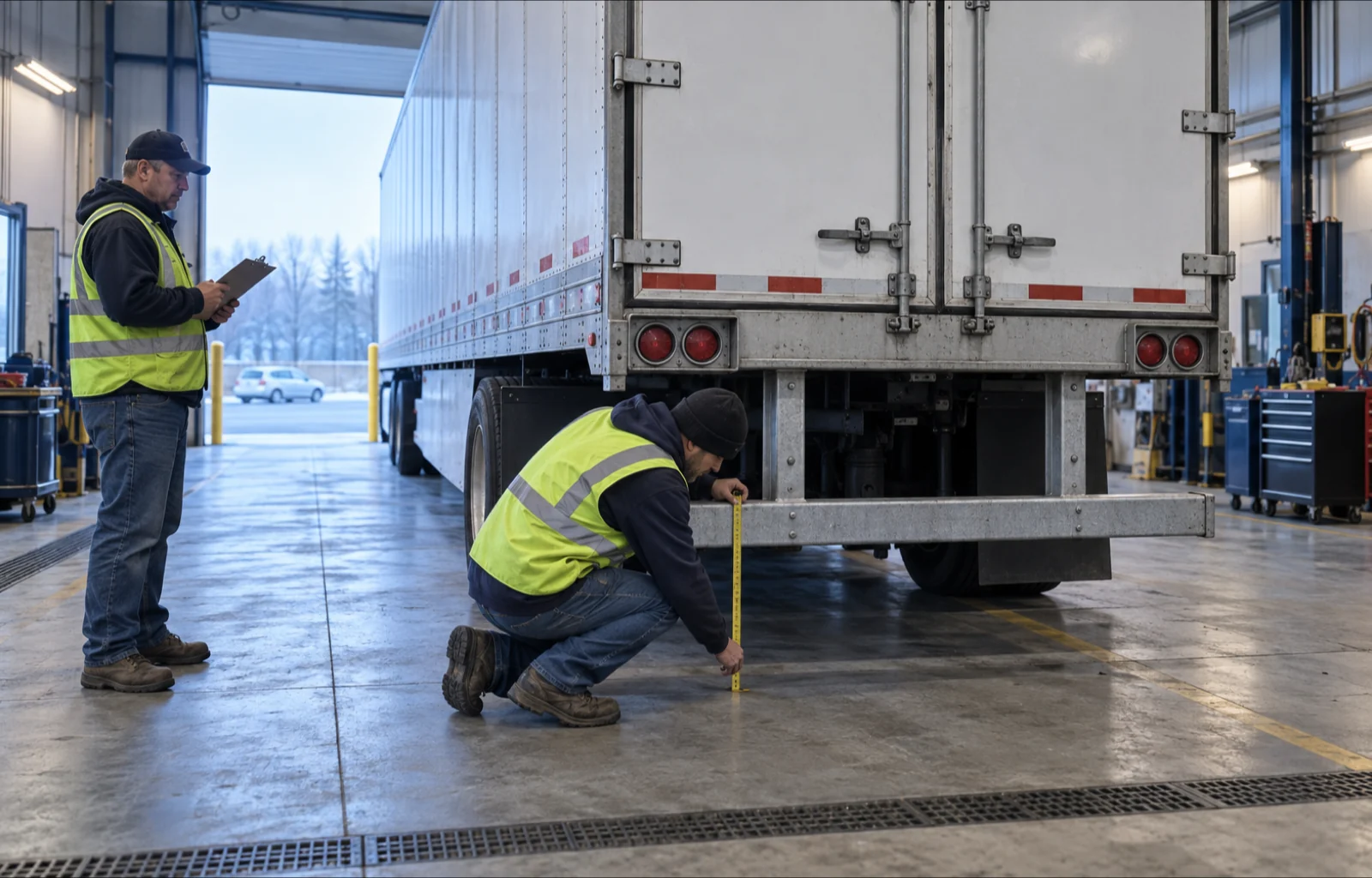
A new trailer-safety award arrives with a boundary that matters as much as the badge. The Insurance Institute for Highway Safety said September 15 that Fruehauf's 53-foot dry van trailers have earned its Toughguard award for rear underride protection. The recognition applies to composite- and aluminum-wall dry vans built after September 30, 2026. It does not describe every Fruehauf trailer already in service, every trailer the company makes, or a retrofit automatically added to an older unit.
A rear underride guard is the steel structure below a semitrailer's rear doors. In a rear-end crash, it is intended to engage a lower passenger vehicle before that vehicle slides far enough under the trailer for the trailer body to enter the occupant compartment. That makes the guard a shared-road safety device, not merely a dock accessory. Its position and connections also explain why a straight-looking horizontal bar alone cannot establish how the complete guard-and-trailer structure would perform under crash load.
IIHS's Toughguard program asks a question beyond the center of the trailer. Its three configurations put a midsize car into a parked semitrailer at 35 mph with the car covering the trailer's full width, 50 percent of the rear, and only 30 percent near an outer corner. The last configuration concentrates the load at the guard's edge, where the car may miss the principal vertical support. IIHS says the qualifying guard must prevent underride in all three configurations. Fruehauf's submitted tests were conducted by MGA Research Corporation and reviewed by IIHS rather than treated as a manufacturer claim without outside evaluation.
Industry sponsor Fewer handoffs. Better visibility. Stronger operations.
See how it works ↗
Fewer handoffs. Better visibility. Stronger operations.
See how it works ↗
The federal floor and the IIHS award are related, but they are not interchangeable. Federal Motor Vehicle Safety Standards 223 and 224 require covered new trailers and semitrailers with a gross vehicle weight rating of at least 10,000 pounds to use a compliant rear impact guard. NHTSA's strengthened rule addresses 35 mph full-width and 50-percent-overlap performance. The agency did not adopt a universal 30-percent low-overlap requirement in that rule; its technical record discusses different crash frequencies, guard designs, weight, cost, and the risk of trading performance in one configuration against another. Toughguard therefore identifies additional tested corner-overlap performance rather than replacing the federal standard.
The paperwork boundary changed this year without erasing the equipment duty. FMCSA rescinded the federal motor-carrier rule that required a rear guard's certification label or marking to remain permanently readable, explaining that labels can wear off during a trailer's service life. The agency explicitly said that change did not alter the applicable federal motor-vehicle safety standards. A separate FMCSA rule continues to place rear impact guards on the required annual commercial-vehicle inspection list. In practical terms, a missing label is no longer the single federal roadside answer, and an award listing is not a substitute for inspecting the physical guard.
For a buyer, fleet or repair shop trying to verify the new recognition, the useful file begins with identity and date: manufacturer, 53-foot dry van body type, wall construction, production date, and any model or equipment detail supplied by the maker. IIHS's public award list supplies the qualifying scope and cutoff. Purchase documents, the trailer identification record, manufacturer documentation and repair history can then show whether the unit belongs inside that scope and whether the original structure has been changed. This is MilesNews editorial guidance, not a new federal recordkeeping mandate. It keeps a September 2026 award from being stretched backward across an older fleet.
Condition is the second question, and it belongs to a qualified inspection rather than a logo search. The annual check should reach the guard that is actually mounted to the trailer, including damage or alterations that could affect its attachment and geometry. A fleet deciding what to buy can use the IIHS list to compare demonstrated performance; a fleet deciding whether a particular trailer is ready for the road still needs its inspection and maintenance process. For everyone traveling behind a dry van, the award is useful precisely because it makes those layers visible: the federal minimum defines the baseline, the 30-percent test identifies an added performance claim, the build date tells which trailers qualify, and today's physical condition determines whether the installed guard deserves confidence.
Route check
- Fruehauf's Toughguard recognition applies to 53-foot composite- and aluminum-wall dry vans built after September 30, 2026—not automatically to older or different trailers.
- The IIHS award includes a 30-percent corner-overlap test in addition to full-width and 50-percent configurations covered by the federal performance floor.
- Verify the trailer's exact identity and build date, then keep the installed guard inside the annual inspection and maintenance process; an award listing does not replace a condition check.