
The toll decision belongs before the lanes split
NTSB counted 1,099 crossings of the striped gore at one hybrid toll plaza. Its new national recommendations show why every payment option has to be clear before high-speed traffic and toll-booth traffic divide.
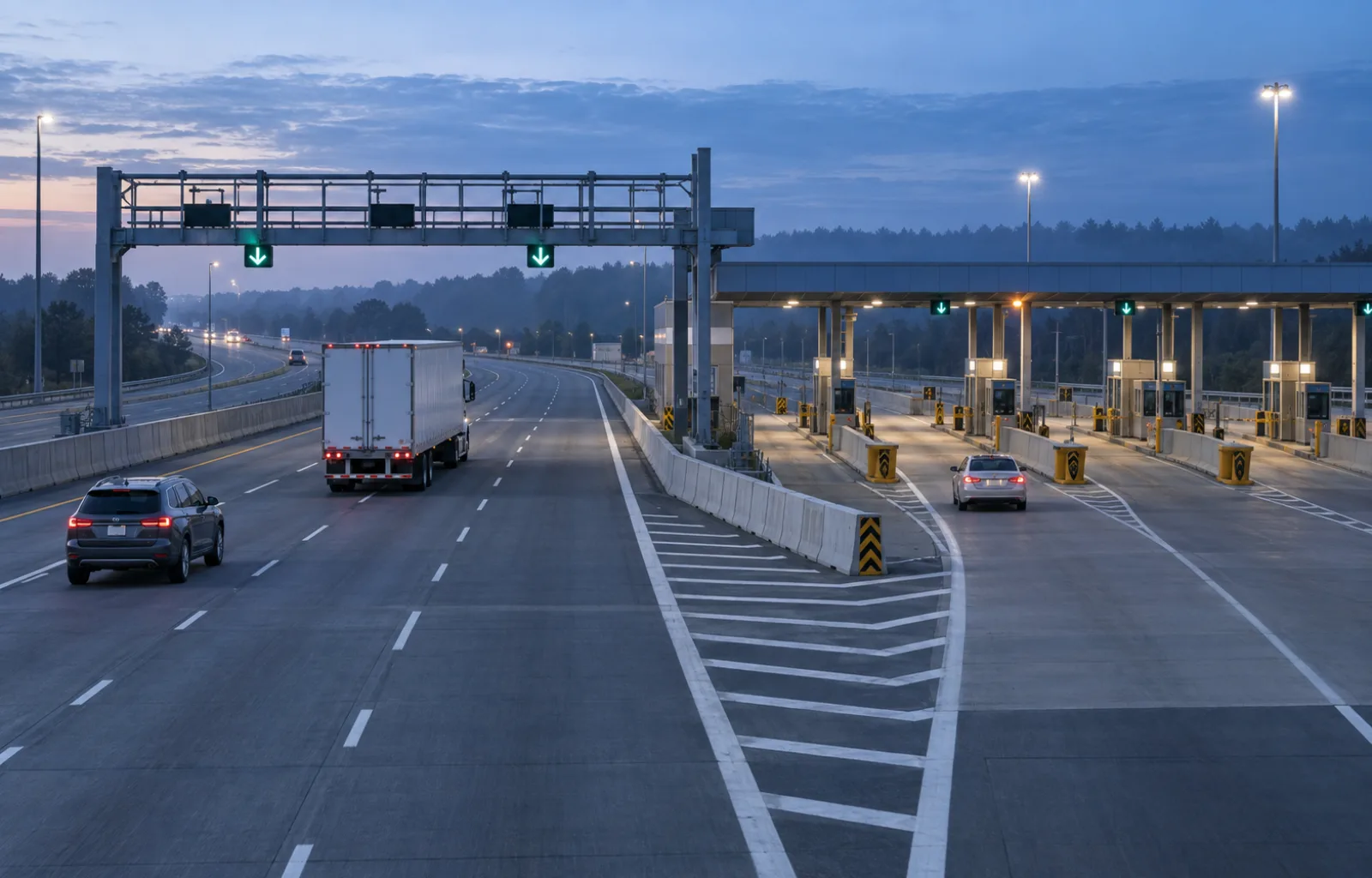
A toll plaza can make a payment choice feel like an immediate driving emergency. A new National Transportation Safety Board investigation shows why the road should prevent that feeling before the lanes separate. The board said September 16 that a fatal 2024 crash on the Ohio Turnpike could have been avoided if the hybrid plaza had used fully electronic tolling and told motorists more clearly that a missed booth toll could be paid online. The finding turns a single crash into a national question about signs, lane design and the moment a driver realizes the intended payment lane is somewhere else.
The crash occurred before dawn on Interstate 80 at the Swanton Township Toll Plaza. The plaza kept two 70 mph electronic lanes in the main roadway while two 10 mph manual-payment lanes split to the right. NTSB data show that an SUV without a transponder slowed and moved toward the low-speed lanes across the path of a combination vehicle. In the final 4.75 seconds, the SUV slowed from 43.5 mph to 14.9 mph while the truck was traveling at 69.6 mph. The resulting closing-speed difference reached 54.7 mph. The truck struck the SUV and overturned; two SUV passengers died, two other SUV occupants and the truck driver were seriously injured, and hazardous materials spilled without causing exposure injuries.
The board did not treat that movement as an isolated mistake. Investigators reviewed about three weeks of toll-plaza video and counted 1,099 clear crossings of the striped gore—the triangular area separating the high- and low-speed paths—an average of 52 per day. They excluded uncertain nighttime views and movements by turnpike or law-enforcement vehicles. The count does not mean 1,099 crashes occurred, and the 51 crashes reported near the plaza during roughly the first year after its hybrid reopening were not all assigned to the same cause. It does show that the lane conflict appeared repeatedly enough to measure before the fatal sequence is considered on its own.
Information was part of the design problem. The high-speed signs identified E-ZPass-only lanes, while manual payment remained on the low-speed side. Yet the upgraded plaza already had license-plate-reading equipment in every lane, and the turnpike could send a bill for online or mail payment. NTSB concluded that the absence of a sign explaining that option contributed to the SUV driver's decision to change lanes. A payment that could have been resolved later instead became a reason for an immediate maneuver across a widening speed gap.
Industry sponsor Keep every mile and every document connected.
Take a closer look ↗
Keep every mile and every document connected.
Take a closer look ↗

That distinction reaches well beyond Ohio. The NTSB recommended that the Federal Highway Administration update national toll-facility standards and guidance so signs explain fully electronic options, not only transponder access, and so operators have current best practices on the safety benefits of all-electronic tolling. It also asked the International Bridge, Tunnel and Turnpike Association to brief its members. During the investigation, the association confirmed that hybrid designs remain in use at facilities in Florida, Maine, New Hampshire, New Jersey, Virginia and Washington state. The recommendations are not a new rule and do not mean every plaza will change at once; they establish a national safety issue for roads that mix through-speed lanes with slower collection lanes.
The Federal Highway Administration's current Manual on Uniform Traffic Control Devices is the national standard for traffic signs, markings and signals. Its toll sections already distinguish transponder-only and plate-billing arrangements. The new NTSB recommendation is more pointed: a driver approaching a hybrid plaza should see every usable payment path early enough to choose without a last-second speed change. Pennsylvania offers a current all-electronic example. Its turnpike says non-E-ZPass traffic continues through a toll point, a camera records the plate and the registered owner receives an invoice. That process is specific to Pennsylvania, not a promise about another toll road, but it shows why the words on the approach sign can change the driving decision.
For a driver, the useful preparation happens before the gantry. Identify the toll operator, accepted transponders, whether plate billing or online payment is available, and whether any vehicle class must use a particular lane. Rental, leased and fleet vehicles deserve an extra check because invoices can travel through an owner or management company rather than directly to the person behind the wheel. Once the lanes begin to divide, preserving a predictable path is safer than trying to repair a payment choice with abrupt braking or a cross-gore move. That is MilesNews editorial guidance drawn from the investigation, not a universal instruction to ignore a toll sign; the road-specific payment and lane rules still control, and an uncertain charge should be researched only after reaching a safe stop.
Heavy vehicles make the shared-road consequence especially visible without making the truck driver the cause of this crash. NTSB found that the SUV's rapid deceleration and lane change produced a speed difference the truck driver did not have enough time to judge and overcome. A tractor-trailer cannot instantly erase highway speed, and a passenger vehicle crossing in front of one can turn a billing problem into a closing-distance problem for both drivers. A useful dispatch note therefore includes the toll system and payment method before the route reaches the plaza, just as it would include a clearance, restricted ramp or permit condition.
For road operators, the report describes a measurable safety program rather than a new slogan. Count cross-gore movements, abrupt decelerations and large speed differences; test whether advance signs explain the payment options drivers actually have; confirm that emergency responders can reach the toll road efficiently; and decide whether low-speed lanes still justify the conflict they create. The board asked Ohio to apply near-term sign and marking improvements at four plazas, then close their low-speed lanes and move to fully electronic high-speed collection. It separately asked for a systemwide review of emergency access points.
The road-level lesson is not that a toll is optional. It is that payment recovery and vehicle recovery operate on different clocks. A missed or uncertain toll can often be researched through the responsible agency after the trip reaches a safe place; a high-speed lane split may offer only seconds and may have no safe late correction. The better system tells drivers that distinction in time. The better trip plan learns it before the lanes split.
Route check
- Check the toll operator, accepted payment methods and any vehicle-specific lane rules before reaching the plaza.
- NTSB counted 1,099 clear gore crossings—52 per day—during its Swanton video review, showing the lane conflict was repeated rather than exceptional.
- If the payment choice becomes uncertain after lanes divide, preserve a predictable driving path and research the road-specific payment process only from a safe stop.