
Two brake warnings call for different responses
An ABS malfunction and falling brake-air pressure describe different problems. Knowing which warning appeared helps a driver protect the stop and helps everyone outside the cab understand the delay.
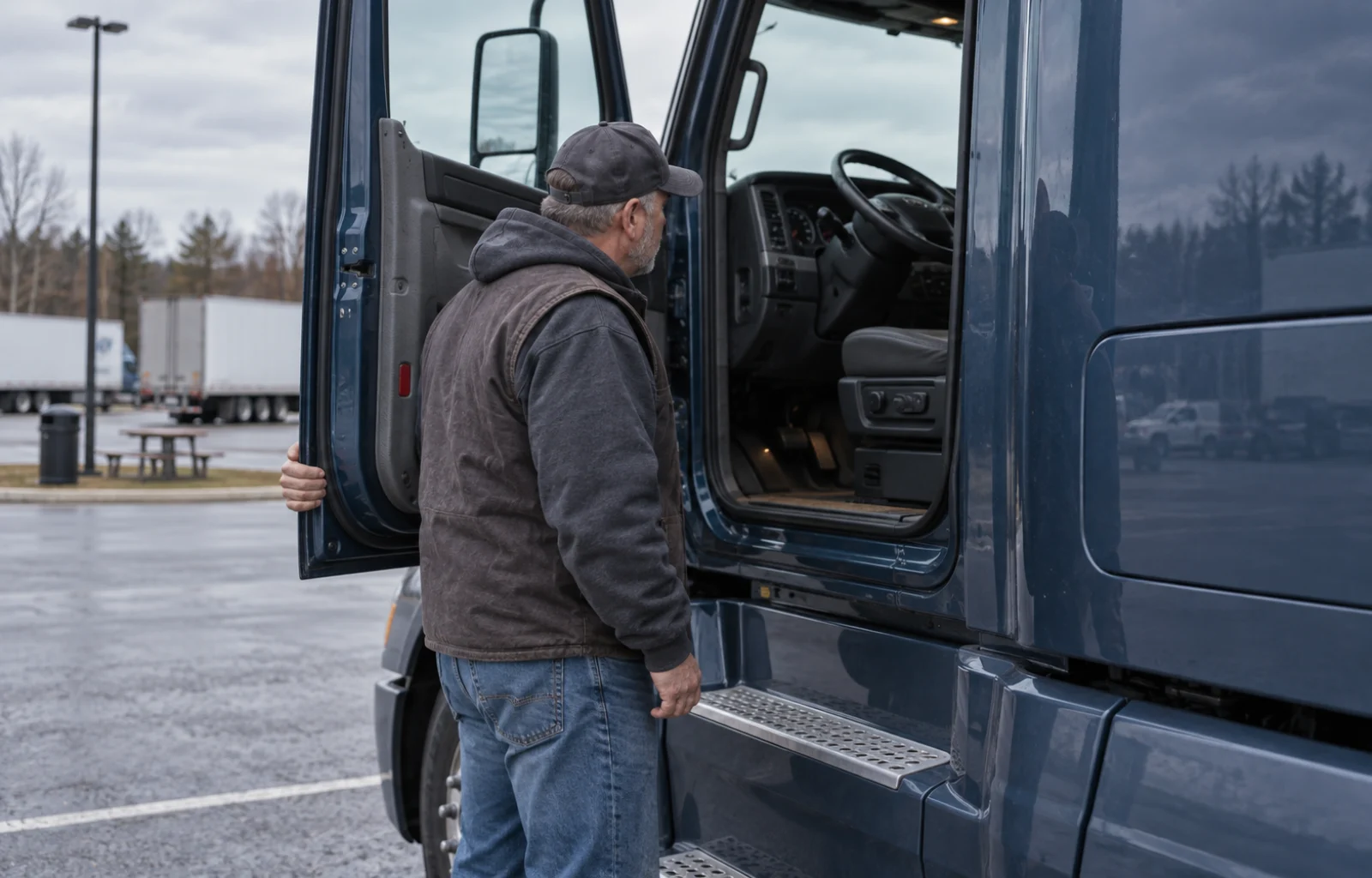
A brake warning interrupts more than the person behind the wheel. It can change a delivery appointment, leave a family waiting for an update, or bring a large vehicle into a safe parking place sooner than expected. But saying the brake light came on leaves out the most useful detail: which warning? A yellow anti-lock braking system lamp and a low-air-pressure warning describe different failures. This vehicle-care resource explains that distinction using current federal requirements, commercial-driver guidance and Commercial Vehicle Safety Alliance material checked October 4. It is an explanation of existing systems, not an announcement of a new rule.
Anti-lock braking, usually shortened to ABS, helps keep wheels rolling when heavy braking would otherwise lock them. CVSA explains that the system adjusts brake force as it detects approaching wheel lock, helping preserve steering control and reduce skidding or trailer swing. The yellow ABS lamp communicates a malfunction; it is not a light that is supposed to celebrate the system helping during a stop. FMCSA makes that distinction explicitly in its motorcoach guidance. A driver therefore needs to recognize the indicator before a difficult braking situation, rather than interpret its meaning for the first time in traffic.
The lamp check matters before departure. CVSA describes a brief illumination when power reaches the system, followed by the lamp going out if the self-test finds no fault. A lamp that never illuminates can itself signal a bulb, wiring or controller problem; permanent darkness is not proof of healthy ABS. A lamp that remains lit or appears during travel also needs attention. Oregon’s commercial-driver manual notes that some older systems keep the lamp on until the vehicle exceeds five miles per hour. Use the procedure for the actual equipment rather than diagnosing every truck from one remembered dashboard sequence.
An ABS fault does not, by itself, mean that the ordinary brakes have disappeared. Oregon’s guidance explains that conventional braking remains when ABS is not working, while the anti-lock assistance may be lost at one or more wheels. That technical distinction is not a clearance to ignore the defect. CVSA says problems should be corrected promptly and identifies malfunction-lamp failures as violations on equipment required to have them. The current federal rule, 49 CFR 393.55, separately specifies ABS and malfunction-indication requirements for covered tractors, other commercial vehicles and trailers. MilesNews editorial advice: report the exact warning and have the responsible maintenance team assess the unit before treating a delivery schedule as permission to continue.
A low-air-pressure warning is a different situation. Air brakes need stored compressed air to operate the service brakes, and a warning during travel can mean that supply is falling. Oregon’s manual instructs the driver to make a safe stop promptly while braking remains controllable, rather than wait for spring brakes to apply automatically as pressure falls further. Its dual-system discussion also warns that a very low circuit can reduce braking at the wheels it serves and lengthen the stop. The exact gauge readings and warning sequence belong to the vehicle’s instructions. A general statement that regular brakes remain after an ABS fault must never be carried over to an air-loss warning.
Industry sponsor From load to settlement, keep it connected.
Follow the workflow ↗
From load to settlement, keep it connected.
Follow the workflow ↗
A tractor and its trailer also need separate attention. Federal requirements include exterior trailer ABS malfunction lamps for covered equipment and circuits that communicate certain towed-vehicle faults to the cab. That means a report should identify whether the indication concerns the power unit or a trailer, rather than use the truck as a catch-all description. MilesNews editorial practice is to record the unit number, the warning’s name, whether it appeared at startup or in motion, any other warnings and the observed gauge readings once safely stopped. Those details help a technician evaluate the complaint; they do not turn a driver into a roadside diagnostician.
The useful preparation is a short conversation before the trip: know the warning indicators, follow the prescribed inspection, and know whom to contact when something changes. For receivers and families, an uncertain arrival time is a reasonable consequence of a brake-system assessment. For motorists nearby, leave room for a large vehicle moving toward a safe stop. Oregon’s general-driving guidance also cautions that ABS does not guarantee a shorter stopping distance or make close following acceptable. Editorial takeaway: understand the message, protect the stopping decision, and communicate the specific fault. A warning needs a response that fits the system it describes.
Route check
- A yellow ABS malfunction lamp reports an anti-lock fault; darkness alone does not prove the lamp works.
- A low-air-pressure warning during travel calls for a prompt safe stop while braking remains controllable.
- Identify the tractor or trailer, exact warning and circumstances so maintenance can assess the problem.